Operational Guide 2025: Emergency Response for Electric Vehicles
Thank you for choosing Automatic Translation. Currently we are offering translations from English into French and German, with more translation languages to be added in the near future. Please be aware that these translations are generated by a third party AI software service. While we have found that the translations are mostly correct, they may not be perfect in every case. To ensure the information you read is correct, please refer to the original article in English. If you find an error in a translation which you would like to bring to our attention, it would help us greatly if you let us know. We can correct any text or section, once we are aware of it. Please do not hesitate to contact our webmaster to let us know of any translation errors.
Below we will post the guides in various languages as they become available. Currently we have versions in English, French, Spanish and Italian.
Introduction: Electric vehicles have been considered as a potential new risk by fire brigades, public authorities, laboratories and private companies for several years now.
This document is currently available for download in English, French, Spanish, Turkish, Finnish, Croatian and Italian. German version is coming soon! More languages may be added.
Hundreds of laboratory tests, field trials, studies, reports, and international guidelines have already been produced.
Equipment manufacturers have offered a wide range of tools designed to help rescue teams operate more efficiently and safely on this type of vehicle.
The rapid growth in electric vehicle sales (initially cars, but now increasingly also trucks and buses) has provided emergency services with valuable operational feedback from those working directly on scene.
However, this accumulated experience has not led to a general consensus on the response procedures to be adopted by fire brigades, whether during a roadside rescue operation or when tackling a fire involving an electric vehicle.
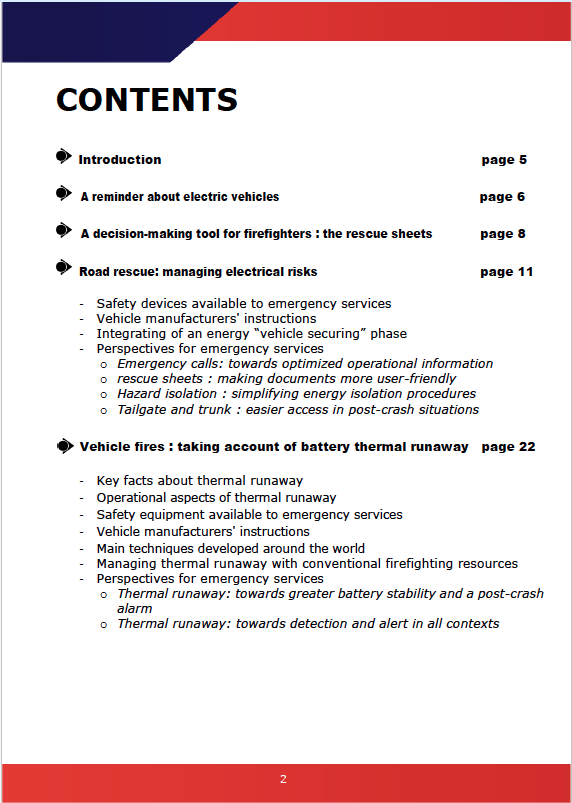
The purpose of this document is to provide an overview of the 2 main issues involved:
-
Managing electrical risks during roadside rescue operations involving electrical vehicles;
-
Managing thermal runaway in the event of an electric vehicle fire (lithium-ion batteries).
The sections covering basic knowledge about electric vehicles and batteries, electric risks and on thermal runaway will be addressed briefly, as extensive literature already exist on these topics.
The document will focus on reviewing the equipment and materials available to the fire brigade to manage these incidents and on proposing practical operational protocols using the traditional resources at their disposal.
Finally, for each of the operational themes (roadside rescue and vehicle fire), we will outline the future perspectives for firefighters, particularly in light of the work currently being carried out by Euro NCAP*.
Thanks for their contribution to:
Amandine LECOQ (FR)
Battery Safety Team Leader INERIS (Institut national de l’environnement industriel et des risques)
Arjan BRUINSTROOP (NL)
Firefighter- NIPV -Training & Operations Advisor – Fire Service Education /CTIF « extrication and new technology » member
Céline ADALIAN (FR)
Senior Manager, Passive Safety IDIADA / ISO 17840 task force Co-chairwoman (rescue sheets)
Eric PAILLIER (FR)
Fire Safety and Emergency Coordinator - TotalEnergies
Joël BIEVER (LUX)
Firefighter - Head of Training southern region, Grand-ducal fire and rescue corps / Vice-chairman CTIF « extrication and new technology » commission
Marco AIMO-BOOT (ITA)
Tertiary Safety Leader IVECO Group / ISO 17840 task force member (rescue sheets)
Pierre CASTAING (FR)
Euro NCAP former president / Chairman Euro NCAP « rescue, extrication and post-crash safety » group
From the foreword by CTIF President Milan Dubravac (Slovenia)
In the past decade, electric vehicles have evolved from a technological novelty into an everyday part of the transportation landscape. They bring important advantages—reduced emissions, quieter operation, greater efficiency—but also new operational and safety challenges. One of the most demanding among them is ensuring safe, effective, and professional firefighting when incidents involve high-voltage battery systems.
The CTIF Extrication and New Technology Commission has continuously monitored the development of electric vehicle firefighting methods with the aim of providing firefighters with appropriate guidance for effective extinguishment, preferably using existing techniques and equipment, which would ensure broad applicability of suitable methods.
The purpose of this operational guide is to provide a comprehensive overview of the approaches, techniques, and tactics for extinguishing electric vehicle fires, based on the latest understanding of battery technology, the behaviour of lithium-ion cells, and the specifics of thermal runaway. The other objective of this guide is to provide an operational response in the event of a road accident involving electric vehicles in order to ensure the safety of the operation in the context of electrical risks.
The operational guide before you brings together practical experience from emergency response teams, research findings, and recommendations from leading experts in fire safety. The focus is not only on extinguishing fires, but also on tactical decision-making, hazard recognition, proper equipment use, and protecting response teams and their surroundings.
Electric mobility is developing rapidly—often faster than many standards and procedures can keep up. For this reason, the core purpose of this book is to offer a solid, up-to-date, and professional foundation that can serve as a guide in demanding and often unpredictable situations. I believe it will provide readers with both the knowledge and the confidence necessary for safe and effective work when dealing with electric vehicle fires.
As the President of CTIF, I would like to express my gratitude to Michel Gentilleau and his colleagues for preparing this manual, which follows the core idea behind CTIF’s mission – the exchange of knowledge to ensure safer work for firefighters and a safer living environment for citizens.