
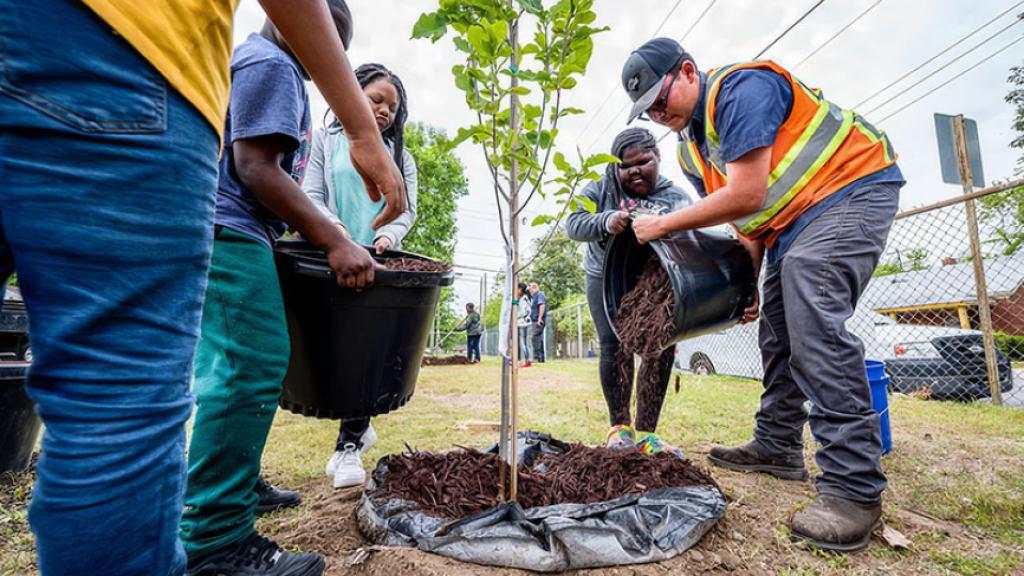
Reforestation not enough: New study warns tree planting alone won’t solve climate crisis
Thank you for choosing Automatic Translation. Currently we are offering translations from English into French and German, with more translation languages to be added in the near future. Please be aware that these translations are generated by a third party AI software service. While we have found that the translations are mostly correct, they may not be perfect in every case. To ensure the information you read is correct, please refer to the original article in English. If you find an error in a translation which you would like to bring to our attention, it would help us greatly if you let us know. We can correct any text or section, once we are aware of it. Please do not hesitate to contact our webmaster to let us know of any translation errors.
A new study published in Science has cast doubt on one of the most popular climate solutions: planting trees.
While forestation has long been hailed as a natural fix for rising carbon emissions, researchers now say its potential has been significantly overstated.
The international team, led by scientists in China, found that only 389 million hectares of land worldwide are truly suitable for afforestation and reforestation—far less than previously estimated. Even if all of this land were planted, the carbon absorption by 2050 would total just 40 billion tonnes. That’s barely more than a single year of global fossil fuel emissions.
The study also highlights a troubling mismatch between government pledges and ecological reality. In Africa, for instance, countries like Ethiopia have committed to reforesting millions of hectares, yet only a fraction of that land is actually viable for tree growth. Much of the pledged land includes savannas and grasslands, which are ill-suited for forestation and rich in unique biodiversity that could be harmed by tree planting.
This isn’t the first time experts have raised concerns. A 2019 critique in Nature Sustainability warned that large-scale tree planting could backfire if done without ecological sensitivity—especially in dry regions where trees compete with native vegetation for water. Similarly, the World Resources Institute has emphasized that while nature-based solutions are vital, they must be paired with aggressive emissions cuts to meet climate goals. https://annforsci.biomedcentral.com/articles/10.1007/s13595-019-0903-2
The new study underscores that forestation should be a complement—not a substitute—for reducing fossil fuel use. Fast-growing tropical regions like Brazil, Colombia, China, and India still offer promising opportunities for carbon capture, but colder countries like Russia and the U.S. would need far more land to achieve similar results.
As the climate clock ticks, scientists urge policymakers to shift focus from symbolic tree-planting campaigns to science-based strategies that prioritize emissions reductions and ecosystem integrity. Planting trees remains part of the solution—but it’s no silver bullet.
You can find the original article discussing the limitations of forestation as a climate solution in Science magazine via this summary on Phys.org. The study, led by a team of scientists primarily based in China, carefully reevaluates how much land is truly suitable for afforestation and reforestation—and concludes that previous estimates were overly optimistic.
If you're looking for the full peer-reviewed study, it was published in Science in early September 2025. You can access it directly through the journal’s website or via academic databases like JSTOR or ScienceDirect, depending on your access. Let me know if you’d like help locating the DOI or citation details.
Read More:
https://phys.org/news/2025-09-trees-wont-forestation-potential-climate.html
https://annforsci.biomedcentral.com/articles/10.1007/s13595-019-0903-2
Photo Credit: Provided courtesy of the City Of Greenville
Creative Commons License: https://creativecommons.org/publicdomain/zero/1.0/
Get this image on: rawpixel.com | License details
Creator: rawpixel.com