
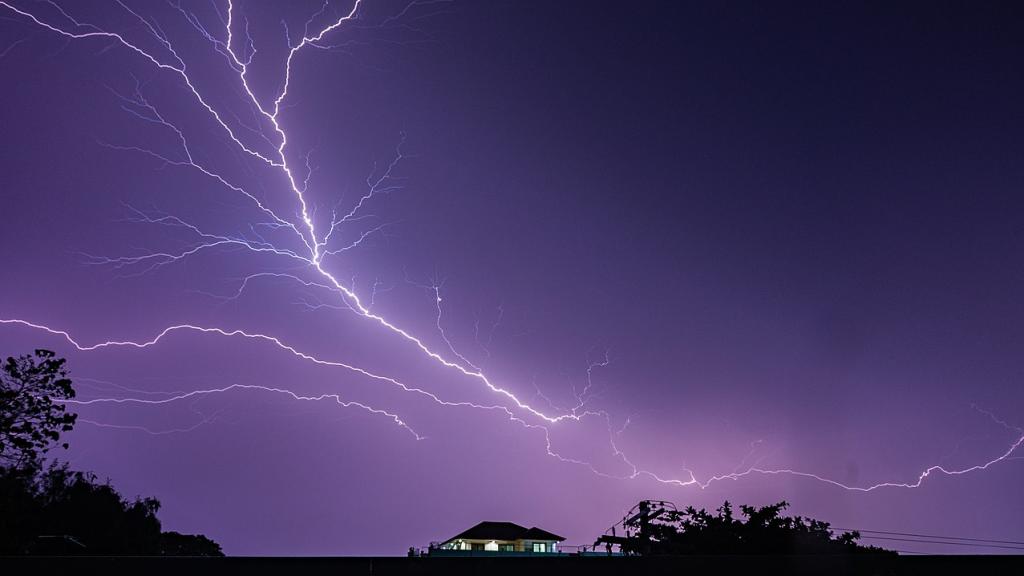
A Swiss team of scientists able to control lightning flashes with powerful lasers
感谢您选择 Automatic Translation。目前,我们提供从英语到法语和德语的翻译,不久的将来还会增加更多翻译语言。请注意,这些翻译是由第三方人工智能软件服务生成的。虽然我们发现这些翻译大部分都是正确的,但并非每种情况下都完美无缺。为确保您阅读的信息正确无误,请参考英文原文。如果您发现翻译中有错误,希望引起我们的注意,请告诉我们,这将对我们大有帮助。我们一旦发现任何文字或章节有误,都会及时更正。如有任何翻译错误,请及时与我们的网站管理员联系。
The old fashioned lightning rod may soon be obsolete: A powerful laser can possible control thunderbolts more effectively and protect larger areas, according to experiments performed last fall in Switzerland.
Traditional lightning rods date back to Benjamin Franklin who used to chase thunderstorms on horseback before his famous kite experiment in 1752. But in more recent times, scientists have looked for other ways to protect buildings and objects from damaging strikes.
The experiment carried out in Switzerland during 2021, consisted of setting up powerful lasers on top of a Swiss mountain, and shooting the lasers onto thunder clouds during heavy storms. In doing so, the scientific team claims to have been able to steer the lighting flashes.
According to an article in The Guardian, one of the scientists behind the experiments, hopes that it will pave the way for new laser-based lightning protection systems at airports, launchpads and tall buildings:
“Metal rods are used almost everywhere to protect from lightning, but the area they can protect is limited to a few metres or tens of metres,” said Aurélien Houard, a physicist at École Polytechnique in Palaiseau.
“The hope is to extend that protection to a few hundred metres if we have enough energy in the laser,” he said to The Guardian.
Lightning bolts are electrical discharges from the atmosphere and are extremely powerful in terms of both voltage and temperature. Lightning causes numerous deaths around the globe every year, and the material damage to buildings and infrastructure that lightning causes can be measured in billions of dollars.
The scientific team has written extensively about their experiments on Nature.com in the article Laser-guided lightning.
To learn more, also read this article in The Guardian, which offers an in-depth summary of the experiments and what their potential real life applications may be in the future.

Photo Credits:
B/W photos by the Swiss scientific team, and published on Nature.com.
Cover photo (above): Lightning near a rural property. Wikipedia Commons License: Own work by Brezhnev30.
